
-- INTRO --
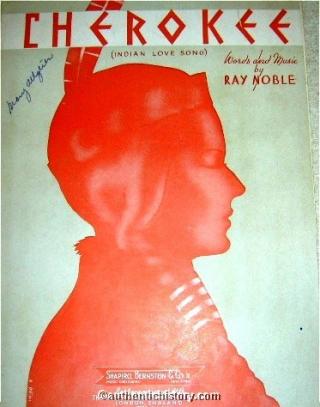
Here you will have the unique chance to listen to mostly all interesting renditions of Ray Noble's "Cherokee", the initial one from 1938 when it was part of an "Indian Suite", Bird's "Koko" in various settings, up to Clifford Brown's classic interpretation.
The fastest "Cherokee" ever - too my knowledge - is the one by Don Byas, recorded some months before "Koko". -- And Bird's most creative, most daring solo on the changes is the one he played at Carnegie Hall on Christmas 1949. Notice the applause when he played those triad motives through all chords on the last bridge. A magic moment.
A tragic moment is his very last recording of "Cherokee"
(with Stan Kenton) when he played the melody all of a sudden, probably just for getting some energy from the audience who recognized the tune, and subsequently applauded, as all US-American audiences do it at the point they'd recognize a popular theme. Doesn't he sound so awfully tired, and exhausted?
Anyway, Ray Noble had no idea, but this piece seemed to be extra created for an ingenious improvisor like Bird. And it really became his leitmotiv through the years, from 1939 on. He owned it so to speak, and he took it to his grave. No one, not even the unique trumpet virtuoso Clifford Brown could play on those changes as convincingly as the one and only Bird.
"Cherokee" / "Koko" was Bird's "Giant Steps": When John Coltrane's LP under this title came out in 1959, it made them other woodwind players sound old fashioned over night. The very same with Charlie Parker's "Koko". -- Benny Goodman hastily threw one native girl on the market too, if you allow me this non-pc rant. Brave, but too late. The boppers were possessive towards the swingers; and they prevailed.
Learn more about “Cherokee”
HERE or
HERE, at Marc Myer’s JazzWax.
Blog owner’s note: Marc interviewed
Mr. Phil Schaap, one of the most illustrious music producers of our time to whom we fans are very grateful, since he discovered, and rediscovered many unpublished, or almost forgotten jazz recordings.
The above is part 1 of the interview, treating Charlie Parker’s “Koko”-session,
here’s part 2; let’s see what part 3 will bring:
HERE,
part 4, and
part 5.

-- Bridge --
Yours truly posted a speculative question there, on #6 my playlist, "Warming Up A Riff"; a question which probably can't be answered because all of the participants of Bird's initial recording session as a leader have left the world's stage:
(...) -- There remains one mystery unsolved though which has again something to do with just another one of Bird's cryptic choice of titles: "Warming Up A Riff".
Questions: What "riff" had to get warmed up? Couldn't it rather be they meant "reed", in the sense of warming up a (new) reed?
This one take - rather kinda jam session, meant as a run-through, as a rehearsal on the changes of "Cherokee" - with no introducing theme, and no out-chorus at a medium-up pace, hasn't it been recorded just accidentally?
I may wildly presume here, but I think the recording engineer asked for the title of this track, and just wrote down what he understood acoustically.
For underlining my above cold-reed theory, I want to add that some of Thelonious Monk's titles have been taken directly from the notes, written down by the particular engineer in charge after he had asked Monk for a particular name of the tune they'd just recorded:
"Worry Later", "Who Knows", "Ask Me Now", or "We See" -- This was a common routine, since most jazz composers are more interested in writing / playing their music than in inventing creative titles.
Side note: But not everybody was so patient, and polite like Thelonious Monk. -- Quoted dialogue from the famous Benny Goodman rehearsal session, after they'd finally recorded one take of a famous sextet number:
Engineer's question from the control room:
"Benny! Do you wanna call it Benny's Bugle?"
Benny's reply:
"Let's go. Let's make a record first. Shut up!"
For avoiding the annoying search for titles, some of my colleagues come up with naming their tunes "Work 1, Work 2 ..." ;)
-- EXTRO --
This little playlist has been compiled for my students at the Cologne Music College in February. It's more or less my lecture on one of jazz's most played, and most challenging compositions. A lecture without words.
Blog owner's note:
The playlist will open in a new window, and so you may read along whilst listening.
01 Cherokee - Ray Noble & His Orchestra, 1938
 02
02 Cherokee - Charlie Barnet & His Orchestra, arranged by Billy May, 1939
03 Cherokee - Charlie Parker Jam, 1941
04 Cherokee - Charlie Parker with Jay McShann, 1942
05 Cherokee - Don Byas (ts), Teddy Brannon (p), Frank Skeete (b), Fred Ratcliffe (d) - May 17, 1945
06 Warming Up A Riff (A Reed?)
07 Koko (aborted)
08 Koko (master) - Charlie Parker's Reboppers - Charlie Parker (as), Dizzy Gillespie (tp, p), Curly Russell (b), Max Roach (d) - WOR Studios, NYC, November 26, 1945
09 Cherokee - Charlie Parker Nat 'King' Cole (p), Oscar Moore (g), Johnny Miller (b), Buddy Rich (d), Hollywood, March-April, 1946
10 Cherokee - Benny Goodman (cl), Red Norvo (vib), Jimmy Rowles (p), Al Hendrickson (g), Harry Babasin (b), Don Lamond (d), Hollywood, June 6, 1947
11 Koko &
Anthropology - Fats Navarro (tp) John LaPorta (cl) Charlie Parker (as) Allen Eager (ts) Lennie Tristano (p) Billy Bauer (g) Tommy Potter (b) Buddy Rich (d) - radio broadcast, NYC, November 8, 1947
12 Koko -
Charlie Parker & Dizzy Gillespie at Carnegie Hall with John Lewis (p) Al McKibbon (b) Joe Harris (d), September 29, 1947
13 MC, "Symphony Sid" Torin
14 Koko
15 MC, "Symphony Sid" Torin - Miles Davis (tp) Charlie Parker (as) Al Haig (p) Tommy Potter (b) Max Roach (d) - "Royal Roost", NYC, September 4, 1948
16 Cherokee - Bud Powell (p), Ray Brown (b), Max Roach (d) - NYC, May, 1949
17 Koko - Charlie Parker (as), Red Rodney (tp), Al Haig (p), Tommy Potter (b), Roy Haynes (d) - Carnegie Hall, December 25, 1949
18 Cherokee - Charlie Parker (as), Stan Kenton & His Orchestra, Arrangement by Bill Holman - Portland, Oregon, February 25 or 28, 1954
19 Cherokee - Clifford Brown (tp) Harold Land (ts) Richie Powell (p) George Morrow (b) Max Roach (d) - Capitol Studios, NYC, February 23, 1955
A breakneck
P.S. with Clifford Brown (tp) Nicky Hill (ts) Sonny Rollins (ts) Chris Anderson (p) Leo Blevins (g) George Morrow (b) Max Roach (d) - "Bee Hive Club", Chicago, IL, November 7, 1955:

My trumpeter colleague and friend Axel Dörner from Berlin sent me this one: Kenny Dorham (tp) George Coleman (ts) Nelson Boyd (b) Max Roach (d) -- Nola's Penthouse Sound Studios, NYC, April 11, 1958:
-- A prosaic P.S. for the ones who want to learn more about my theory on "Warming Up A Riff" --
The squeaking reed can be heard at the first three takes of "Billie's Bounce"
(the first new tune they recorded that day). -- Bird went to a saxophone repair shop then, just to come back with a new reed which had to be warmed up. Sounds completely logical to me. --
And if you're listening more closely to that particular recording:
The track is starting right during the 3rd A section of "Cherokee"
(last eight bars of the chorus), which indicates that the engineer must have turned on the mike spontaneously, only because he wanted to capture the rest of that great moment when Dizzy accompanied Bird at the piano; and they had a lot of fun as one can clearly notice. Dizzy laughs out loudly about Bird's quotation of "Cocktails For Two", and how he ingeniously made it fit in the changes of "Cherokee".
-- Now, back to "Koko" --
They'd played the melody of "Cherokee" at "Koko's" first, but then interrupted take. Whistling, and shouting from the control room -- take 2 -- perfection -- great musical history was made. -- It can be as easy as that sometimes. (Miles could play the intro too some years later! -- #14 on the playlist proves it.)
What makes me always wonder, is, how quickly Dizzy had managed it to switch from trumpet to piano.
He didn't need more than two seconds for that. It's simply amazing. Diz claimed in his autobiography that one could hear his footsteps as he walked to the piano; I'd rather say he sprinted to the stool, but alas, even with head-phones: I can't hear any footsteps.
So, who is the ghost pianist at the aborted take #1 while they both, Bird & Diz, still were at it, playing the melody of "Cherokee"? -- Bud Powell was invited but couldn't make it, 'cause he was in Philadelphia with his mother. So, Bird had to look for another pianist who knew how to play the new music. The only one available was young
Argonne Thornton who became a Muslim later on, and is better known under his adopted name
Sadik Hakim.
It's questionable though, if Argonne could have properly delivered the Monkish blues chords like Dizzy did it at
Billie's Bounce, and
Now's The Time. Argonne's uninspired, unimaginative, and strangely phrased solo contributions on
Thriving On A Riff (Anthropology) from the same date hint to the fact that he was actually only a stopgap. -- So, they still needed a pianist for "Koko", and the two blues numbers right now!
Dizzy was also an able pianist who was completely aware of what he was doing. He knew the modern chords, he was the "theoretician" who had extensively practiced, and discussed the new music with Thelonious Monk, Kenny Clarke, and Oscar Pettiford. That's why he eventually got the job. Diz loved to accompany Bird's improvisations anyway, and he was always curiously checking out Miles' new ideas.
As for the
(other?) pianist at "Koko":
Both takes have piano accompaniment right from the start of both, the
(accidentally played?) theme of "Cherokee", and the saxophone solo of the 2nd take. After even closer listening
(I can't tell you how often I have checked that), and reading James Patrick's liners from the "Bird on Savoy" LP-box set, I still can only guess, but it's highly probable that Sadik Hakim played the first two A-parts, and then cleared the way for Dizzy who took over the piano stool for the rest of the solo.
The somewhat more confident, and darker comping on the following bridge, and the rest of "Koko" definitely indicates this, at least for me. Max Roach's flabbergasting drum solo will have served as a break for Dizzy, since he had to play trumpet on the outro again. --
Side note: I can imagine all young drummers listening to that recording with an open mouth, and blushing ears when it came out.
-- Announcement --
As soon as I find the time I will post a whole thread about Charlie's other cryptic titles "Ah-Leu-Cha", "Klaunstance", and of course the famous "Klact-Oveeseds-Tene"
(which I did, at least about "Klact-Oveereds-Tene").
And so: Stay tuned!
-- Now, what to purchase, and where? --
The complete "Koko Session" in the correct order of the recorded tracks can be found on various CD's, and of course LP's.
Here is a little selection:
Only one website among numerous others which are offering a whole load of LP's:
HERE
-- An unaltered anonymous quote from ages ago, found somewhere on the internet --
There was the war, when shellac for records was in short supply; there was a self-imposed ban (starting in the summer of 1942) by the American Federation of Musicians on doing commercial recordings, in other words, a strike, over the issue of musician royalties.
So there was little or no official recording activity during those years, aside from V-discs made for the Yanqui troopses overseas and such (plus some late-night scab activity); there are radio broadcasts that are now preserved, but they were never meant to be put on the market as records.
Frank Sinatra had a hit (as the singer with Tommy Dorsey's big band), with "I'll Never Smile Again", sidestepping the ban by doing the song a capella with a vocal group -- no musicians. Singers aren't musicians :)
The ban was lifted at the end of 1944; some up-and-coming musicians lost out on a possible chance at stardom during the ban years -- the Earl Hines band had included people like Billy Eckstine, Sarah Vaughan (doubling as a pianist as well as a singer), Charlie Parker, and Dizzy Gillespie. If they'd had a recording contract, they might well have been the hippest big band around.
So now it's 1945, Savoy Records has signed Parker to a contract, and he's in a Manhattan recording studio on November 26th for the first time as a leader, with the intention of recording four tunes -- the A and B-sides to a pair of 78-rpm discs. It's a quintet -- Parker, teenage trumpeter Miles Davis, Bud Powell on piano, Curley Russell on bass, and Max Roach on the drums.
But Powell can't make it to the recording date -- he's in Philadelphia with his mother. Argonne Thornton (later to be known as Sadik Hakim) is supposed to be there as Bud's replacement, but he isn't there either; Gillespie, accompanying his friend Parker on this auspicious occasion, will deputise the deputy pianist -- he has the chops to do it, despite only being known as a trumpeter.
It's time to start; no sign of Hakim yet. Diz is at the piano, but young Miles is having trouble with the intro to "Cherokee", a furious trumpet/alto sax duet over the drums. So Diz takes over on trumpet, leaving no pianist, but that's OK. The intro is handled fine, with short solos for the two horn players, then they launch into the tune's actual melody. Someone -- maybe Savoy's Teddy Reig -- brings the recording to a halt after a couple of bars; you can almost hear him leap out of the control room chair and onto the studio floor, whistling the proceedings to a stop.
Reig explains that they can't do "Cherokee", because it means Savoy would have to pay composer royalties to an outside entity -- the publisher and composer of the song, which had been a big hit for Charlie Barnet's big band, once upon a time. So "Cherokee" is done sans melody statement; after the horn-duet intro, you can hear Diz miraculously ease into the piano accompaniment, and Parker just cuts straight to the sax-solo part, several choruses of melodic invention at the same lightspeed tempo as the intro.
To the uninitiated or the casual jazz listener, with jazz history having been frozen by the war, the music must have been the equivalent of humanoid beings landing at Area 51. Humanoid, but not quite human enough for comfort. After a brief drum solo, Diz grabs his trumpet, and the duet intro is played again -- The End.
The intro is now a theme, the theme to a tune called "Koko", as it was originally spelled that day. Hakim shows up, Miles returns to the trumpet chair, and the quintet finish three more tunes that day -- a pair of blues numbers, "Billie's Bounce" and "Now's the Time", and "Thriving on a Riff", an impromptu, themeless improvisation like "Koko" (IIRC, or was "Warming Up a Riff" the themeless one?).
The rest is... ...a gas!!! You dig?
-- Addendum --
For the completists, a little list of all recorded versions of "Cherokee" or "Koko", played by Charlie Parker in various settings between late 1941 or early '42 & 1954:
1. - Kansas City Band:
Cherokee
Charlie Parker (as) Efferge Ware (g) Little Phil Phillips (d) - Vic Damon Studio, Kansas City, KS, September, 1941, 1942 (could be as well from Autumn 1943; but since Bird was born in Kansas City, it all starts here for me.)
2. - Clark Monroe:
Cherokee
unknown (tp) Charlie Parker (as) unknown (sax) Al Tinney (p) Ebenezer Paul (b) unknown (d) Clark Monroe (vo) - Clark Monroe's Uptown House, NYC, January-March, 1942
3. & 4. - Charlie Parker Reboppers:
Warming Up A Riff &
Koko
Miles Davis (tp -2/13) Charlie Parker (as) Sadik Hakim (p -11/13) Dizzy Gillespie (p -1/10,16, tp, p -14,15) Curly Russell (b) Max Roach (d)
WOR Studios, Broadway, NYC, November 26, 1945
5. - Charlie Parker With Nat King Cole Trio:
Cherokee
Charlie Parker (as) Benny Carter, Willie Smith (as -1) Nat "King" Cole (p) Oscar Moore (g -1) Johnny Miller (b -1) Buddy Rich (d) - Los Angeles, CA, March-April, 1946
6. - Charlie Parker Welcome Session Band:
Home Cookin' II
Charlie Parker (as); Howard McGhee (tpt); Melvin Broiles (tpt); Harold "Shorty" Rogers (tpt); Russ Freeman (p); Arnold Fishkind (b); Jimmy Pratt (d) - Chuck Kopely's apartment, Hollywood CA, February 1, 1947
7. - Barry Ulanov's All Star Modern Jazz Musicians:
Koko (I), played as radio theme with voice over.
Dizzy Gillespie (tp) John LaPorta (cl) Charlie Parker (as) Lennie Tristano (p) Billy Bauer (g) Ray Brown (b) Max Roach (d) Bruce Elliott, Barry Ulanov (ann) - WOR radio broadcast, "Bands For Bonds", NYC, September 13, 1947
8. - Barry Ulanov's All Star Modern Jazz Musicians:
Koko (II), played as radio theme with voice over.
Dizzy Gillespie (tp) John LaPorta (cl) Charlie Parker (as) Lennie Tristano (p) Billy Bauer (g) Ray Brown (b) Max Roach (d) Carl Caruso (ann) - WOR radio broadcast, "Bands For Bonds", NYC, September 20, 1947
9. - Dizzy Gillespie Quintet:
Koko
Dizzy Gillespie (tp) Charlie Parker (as) John Lewis (p) Al McKibbon (b) Joe Harris (d) - radio broadcast, "Carnegie Hall", NYC, September 29, 1947
10. - Barry Ulanov and His All-Star Metronome Jazzmen: Koko (III), incomplete version without the famous introduction, but with great solos by the participating musicians. Voice over during Lennie's solo, goes into "Anthropology" then. This is by the way Theodore "Fats" Navarro's only known solo on "Cherokee".
Charlie Parker (as); Theodore "Fats" Navarro (tpt); John La Porta (cl); Allen Eager (ts); Lennie Tristano (p); Billy Bauer (g); Tommy Potter (b); Buddy Rich (d); Bruce Elliott (ann); Barry Ulanov (ann) - Mutual Studios, NY, WOR radio broadcast, November 8, 1947
11. - Dixieland vs. Bebop All-Stars:
Koko
Charlie Parker (as); Charlie Walp (tpt); Earl Swope (tb); Ben Lary (ts); Sam Krupit (p); Mert Oliver (b); Joe Theimer (d); Art Phipps (b); Buddy Rich (d); Wild Bill Davison (cornet); Benny Morton (tb); Tony Parenti (cl); Jackson Lowe (ann); Willis Conover (ann) - Washington Music Hall, Washington DC, May 23, 1948
12. - Charlie Parker Quintet:
Koko
Miles Davis (tp) Charlie Parker (as) Al Haig (p) Tommy Potter (b) Max Roach (d) - "Royal Roost", NYC, September 4, 1948
13. - Jazz At The Philharmonic All Stars:
Cherokee
Charlie Parker (as); Theodore "Fats" Navarro (tpt); Tommy Turk (tb); Sonny Criss (as); Flip Phillips [Joseph Filipelli] (ts); Coleman Hawkins (ts); Hank Jones (p); Ray Brown (b); Shelly Manne (d); Ella Fitzgerald (voc); Mario Bauza (tpt); Frank "Paquito" Davilla (tpt); Bob Woodlen (tpt); Gene Johnson (as); Fred Skerritt (as); Jose Madera (ts); Leslie Johnakins (bs); Rene Hernandez (p); Roberto Rodriguez (b); Jose Mangual (bgo); Luis Miranda (cga); Umbaldo Nieto (timbales); Frank "Machito" Grillo (maracas); Norman Granz (ann) - Carnegie Hall, NY, February 11, 1949
14. - Charlie Parker Quintet:
Koko
Charlie Parker (as); Kenny Dorham (tpt); Al Haig (p); Tommy Potter (b); Max Roach (d) - Pershing Hotel Ballroom, Chicago IL, March 28-April 10, 1949 (?)
15. - Charlie Parker Quintet:
Koko
Red Rodney (tp) Charlie Parker (as) Al Haig (p) Tommy Potter (b) Roy Haynes (d) - "The Stars Of Modern Jazz", "Carnegie Hall", NYC, December 24, 1949
16. - Apartment Jam Sessions:
Cherokee
John Nielson (tp) Jimmy Knepper (tb) Joe Maini, Charlie Parker (as) Don Lanphere (ts) Al Haig (p) unknown (b) Frank Isola (d) - probably NYC, circa 1950
17. - Stan Kenton & His Orchestra With Charlie Parker:
Cherokee
Buddy Childers, Vic Minicheli, Sam Noto, Don Smith, Stu Williamson (tp) Joe Ciavardone, Milt Gold, George Roberts, Frank Rosolino (tb) Charlie Mariano, Charlie Parker, Dave Schildkraut (as) Mike Cicchetti, Bill Perkins (ts) Tony Ferina (bars) Stan Kenton (p) Bob Lesher (g) Don Bagley (b) Stan Levey (d) - "Civic Auditorium", Portland, OR, February 25, 1954
My special thanks goes to JAZZDISCO.org & PLOSIN.com for their priceless efforts.

Here comes
A VERY BIG P.S. by the Duke of Ellington, namely a remake of *his*
Ko-Ko from 1940:
[youtube http://www.youtube.com/watch?v=O3R11NaEiW4&w=320&h=215]


 Prologue



 02 Cherokee - Charlie Barnet & His Orchestra, arranged by Billy May, 1939


